How Energy-Efficient Kitchen Appliances Make Smart Cooking Better
November 19, 2025Discover how energy-efficient gas hobs, high-performance range hoods, and modern ovens combine advanced engineering, lower energy consumption, powerful performance, intelligent safety, and smart cleaning technology. From gas-saving burners and instant ignition to high IEC airflow, strong static pressure, Nano grease separation, patented blower systems, and efficient AC and BLDC motors, modern kitchen appliances are designed to deliver more performance while using resources more intelligently.
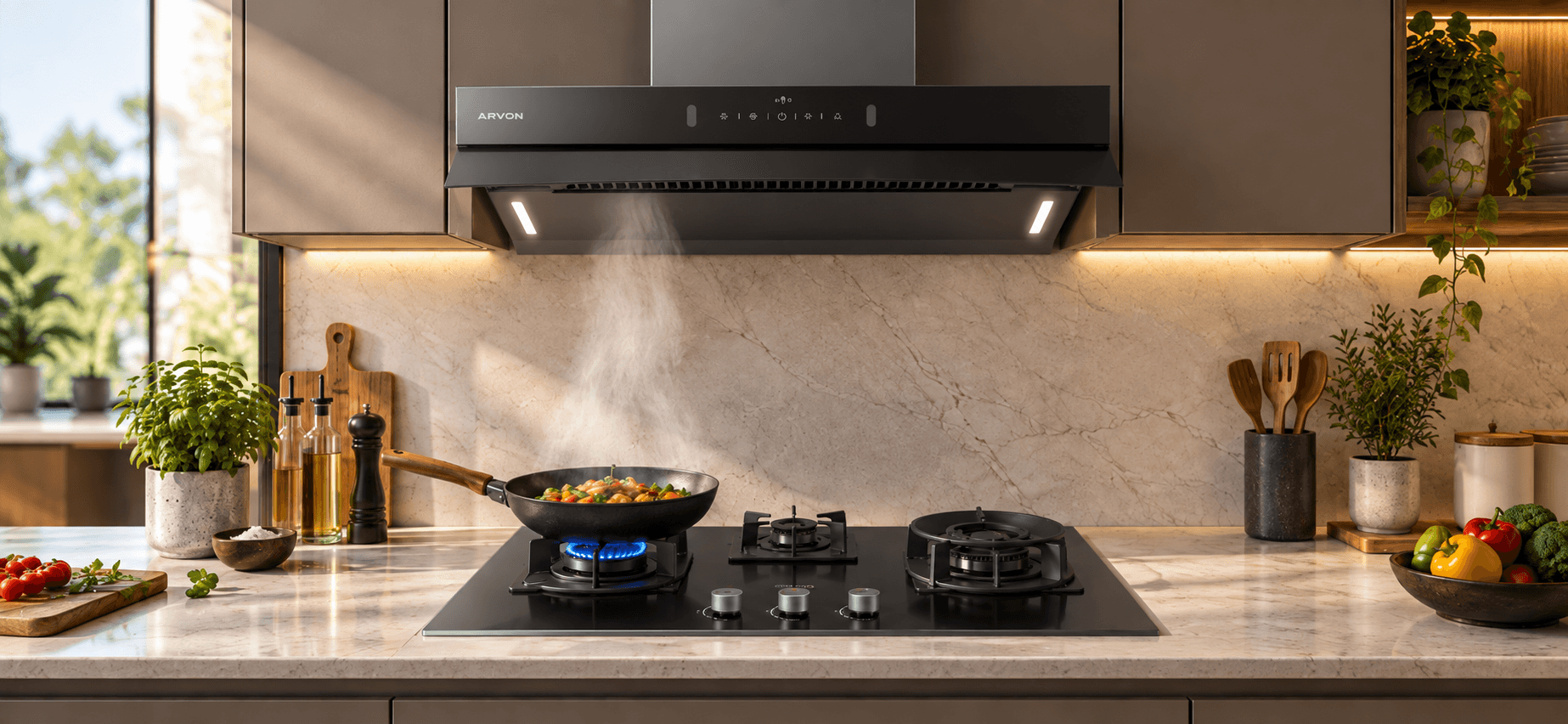
Energy efficiency in the modern kitchen is no longer simply about using less electricity or gas. A truly efficient appliance should deliver stronger performance from the energy it consumes, reduce unnecessary waste, shorten cooking or ventilation time where possible, and remain reliable through years of everyday use.
This is why modern gas hobs, range hoods, and ovens are increasingly engineered around a balance of performance and efficiency. Advanced burner technology, optimized airflow, efficient motors, better grease management, intelligent controls, and improved heat management allow appliances to perform more effectively without wasting resources.
For a gas hob, efficiency begins with how effectively the burner converts gas into usable cooking heat. A powerful burner is not necessarily efficient if a large amount of heat escapes around the cookware. Well-engineered burner systems direct the flame toward the cooking vessel, helping improve heat transfer and reduce unnecessary gas consumption.
Selected Arvon gas hobs are engineered with Gas-Saving Technology designed to deliver up to 13% gas savings while providing up to 12% faster cooking performance. With a heating efficiency of up to 63%, the burner system is designed to transfer heat effectively while delivering the strong flame required for everyday cooking.
High-output brass burners, including powerful triple-ring Dual Flame burners on selected models, provide flexibility for different cooking requirements. High heat can be used for rapid boiling, frying, and searing, while precise flame adjustment allows gentle simmering and lower-temperature cooking.
Efficiency is also connected to convenience. Patented Instant Ignition allows the flame to start quickly without repeated ignition attempts, while smooth flame controls help users select only the amount of heat required for the task.
Safety is equally important. A Flame Failure Device (FFD) can automatically stop the gas supply when the flame is accidentally extinguished. By combining efficient burners, instant ignition, precise control, stable cast iron pan supports, and safety technology, a modern gas hob can provide both economical and confident everyday cooking.
The range hood is another area where efficiency is often misunderstood. A range hood should not be judged only by its airflow number. Effective ventilation depends on the relationship between airflow, static pressure, blower efficiency, duct resistance, motor performance, and grease separation.
Selected Arvon Range Hoods deliver Standard IEC airflow from approximately 1440 m³/h to 1560 m³/h, depending on the model. Models with around 500 Pa maximum static pressure provide strong everyday extraction, while premium BLDC configurations can reach up to 1200 Pa maximum static pressure.
Static pressure is particularly important because a range hood must push contaminated air through ducting, bends, and other resistance. A hood with strong airflow but insufficient pressure may lose performance once connected to a real exhaust system. Combining high IEC airflow with strong static pressure therefore provides a more complete indication of ventilation capability.
Arvon Range Hoods also use fully sealed AC or BLDC motor systems, depending on the model. A BLDC motor can provide strong performance with precise motor control and high air pressure, while a properly engineered sealed AC motor can offer robust and dependable everyday operation.
Grease management also has a direct impact on long-term efficiency. Selected Arvon models use Nano Technology combined with a patented blower system to separate grease and oil from the airflow before excessive contamination reaches critical internal components.
Depending on the model, Arvon Range Hoods provide oil and grease filtration rates of around 90% to 92%. Effective grease separation can help keep the blower and internal airflow path cleaner, supporting more stable performance over time.
Some models take maintenance efficiency further through an Automatic Self-Cleaning System. After 60 hours of cumulative operation, the intelligent cleaning cycle activates automatically on supported models to help reduce grease accumulation inside the range hood.
By combining Nano grease separation, patented blower engineering, self-cleaning technology, sealed motors, touch controls, hand-gesture control, and 2+1 Turbo speed settings, modern range hoods can deliver powerful extraction without creating unnecessary work for the user.
Speed control also contributes to energy efficiency. Maximum extraction is not required for every cooking task. 2 standard speeds plus 1 Turbo mode allow the user to choose an appropriate extraction level instead of running the hood at maximum power continuously.
Modern ovens follow the same principle. Good insulation reduces heat loss, while convection systems circulate hot air more evenly through the cooking chamber. Digital temperature controls, programmable timers, and automatic cooking functions help avoid unnecessary heating time and make it easier to use the correct settings for each dish.
Energy-efficient design therefore goes far beyond adding an “eco” function. It involves engineering every part of the appliance to use energy more intelligently—from burner geometry and flame control to motor efficiency, airflow management, insulation, automatic cleaning, and user controls.
The result is a kitchen where performance and efficiency work together. A gas hob can deliver powerful heat while reducing gas consumption. A range hood can provide high airflow and strong static pressure while intelligently managing grease and motor operation. An oven can maintain cooking temperature more effectively while minimizing unnecessary heat loss.
Choosing energy-efficient appliances is therefore not about sacrificing performance. The best modern kitchen technology aims to deliver more effective cooking, cleaner air, lower resource waste, easier maintenance, dependable safety, and greater long-term value.
For a truly smart kitchen, efficiency should be built into the engineering—not added as an afterthought.